


Shoulder impingement occurs when the rotator cuff tendons or bursa become compressed between the bones of the shoulder joint. This compression can lead to inflammation, irritation, and a cascade of symptoms that can hinder even the simplest tasks. Understanding shoulder impingement, from its underlying causes to the various treatment options available, supports effective management and recovery.
Key Takeaways
- Shoulder impingement occurs when the rotator cuff tendons or bursa are pinched between the bones of the shoulder.
- Common causes include repetitive overhead activities, poor posture, anatomical variations, and muscle imbalances.
- Treatment options range from conservative methods like rest, physical therapy, and medication to surgical interventions for persistent or severe cases.
Understanding the Shoulder: A Complex Joint
The shoulder is a ball-and-socket joint and is one of the most mobile joints in the human body. This mobility, however, comes at the cost of stability, making it susceptible to various injuries and conditions. The joint is composed of three bones: the humerus (upper arm bone), the scapula (shoulder blade), and the clavicle (collarbone).
The scapula features a bony projection called the acromion, which forms a roof over the shoulder joint. Beneath this acromion lies a narrow space known as the subacromial space. This area houses several structures: the rotator cuff tendons and the subacromial bursa.
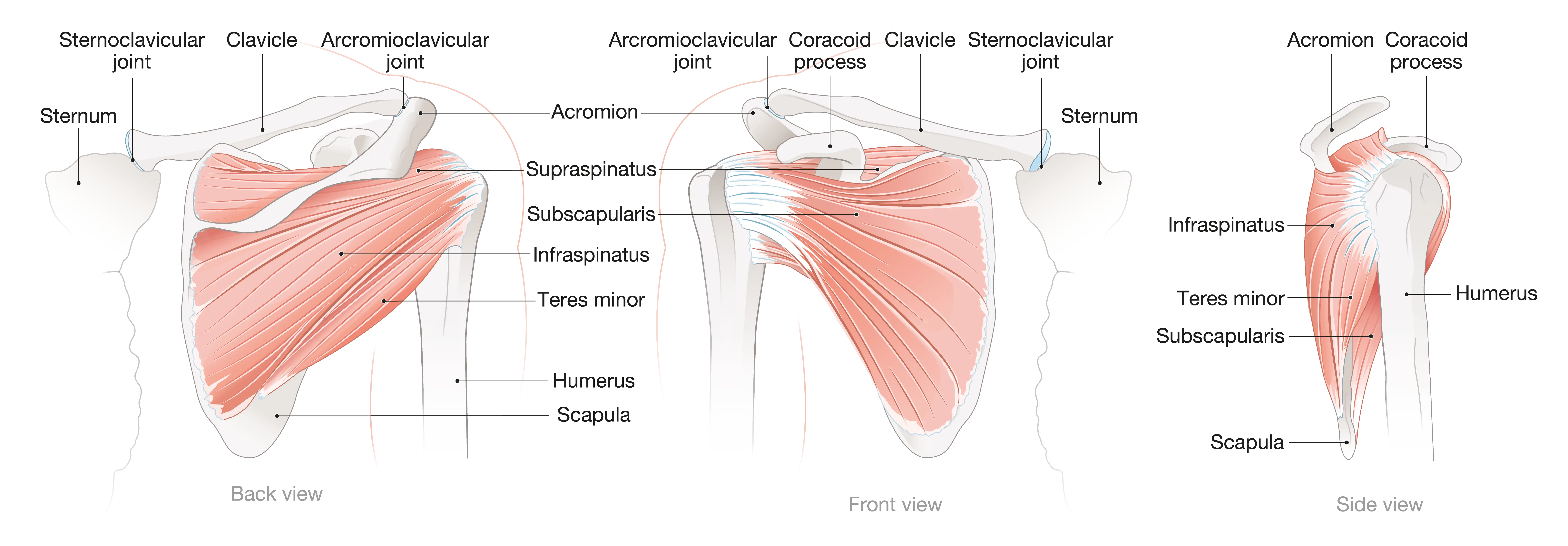
The rotator cuff is a group of four muscles (supraspinatus, infraspinatus, teres minor, and subscapularis) and their tendons that surround the shoulder joint, providing stability and enabling a wide range of movements, particularly rotation and lifting the arm. The subacromial bursa is a fluid-filled sac that acts as a cushion, reducing friction between the rotator cuff tendons and the acromion during arm movement.
Shoulder impingement occurs when these soft tissues, primarily the rotator cuff tendons and the subacromial bursa, become compressed or pinched within the subacromial space. This compression typically happens during overhead arm movements, such as reaching, lifting, or throwing.
When this repeated compression occurs, it can lead to inflammation (tendinitis in the rotator cuff, bursitis in the bursa), pain, and a reduction in the shoulder’s functional capacity. Over time, chronic impingement can weaken the rotator cuff tendons, potentially leading to partial or full rotator cuff tears if left unaddressed.

What Causes Shoulder Impingement?
Shoulder impingement is rarely caused by a single event; rather, it often develops gradually due to a combination of factors. The causes can generally be categorized into intrinsic (factors within the shoulder joint) and extrinsic (factors outside the shoulder joint).
Intrinsic Factors:
- Rotator Cuff Tendinopathy: Degeneration or inflammation of the rotator cuff tendons can cause them to swell, making them more susceptible to impingement. This may result from overuse, aging, or microtrauma.
- Bursitis: Inflammation of the subacromial bursa (subacromial bursitis) can lead to swelling, reducing the space available for the rotator cuff tendons and increasing the likelihood of impingement.
- Bone Spurs (Osteophytes): Over time, bone spurs can develop on the underside of the acromion. These bony growths can narrow the subacromial space, directly impinging on the soft tissues during arm movement.
- Acromial Shape: The shape of the acromion itself can predispose individuals to impingement. Some people have a flat acromion (Type I), while others have a curved (Type II) or hooked (Type III) acromion. Type II and Type III acromions may reduce the subacromial space, increasing the risk of impingement.
Extrinsic Factors:
- Repetitive Overhead Activities: Athletes involved in sports like swimming, baseball, tennis, and volleyball, as well as individuals whose occupations require frequent overhead arm movements (e.g., painters, construction workers), are at a higher risk. The repeated motion can lead to overuse and inflammation of the rotator cuff and bursa.
- Poor Posture: Forward head posture and rounded shoulders can alter the normal mechanics of the shoulder joint, reducing the subacromial space and contributing to impingement. This posture can tilt the scapula forward, bringing the acromion closer to the humeral head.
- Muscle Imbalances and Weakness: Weakness in the rotator cuff muscles or the scapular stabilizing muscles (muscles that control the shoulder blade) can lead to abnormal shoulder mechanics.
- Trauma: A direct injury to the shoulder, such as a fall or a sudden impact, can cause inflammation or damage to the structures within the subacromial space.
- Age-Related Degeneration: As individuals age, the tendons and bursae naturally become less elastic and more prone to wear and tear, increasing the susceptibility to impingement.
Understanding these diverse causes highlights why a thorough evaluation by an experienced shoulder specialist is frequently recommended to identify the specific factors contributing to an individual’s shoulder impingement and to formulate an effective treatment plan.
Recognizing the Symptoms of Shoulder Impingement
The symptoms of shoulder impingement can vary in intensity and presentation, but they typically share common characteristics that can help in early identification. Recognizing these signs is the first step toward seeking appropriate medical attention. The most common symptoms include:
- Pain: The pain is often described as a dull ache in the outer part of the shoulder, sometimes radiating down the arm towards the elbow. It typically worsens with overhead activities, reaching behind the back, or lifting the arm to the side. Night pain, especially when lying on the affected shoulder, is also common and can disrupt sleep.
- Weakness: Patients may experience a feeling of weakness in the affected arm, particularly when attempting to lift or rotate it. This weakness can be due to pain inhibiting muscle function or, in more severe cases, due to actual damage to the rotator cuff tendons.
- Reduced Range of Motion: The ability to move the arm through its full range of motion may be limited, especially when trying to lift the arm overhead or reach across the body. This restriction can be due to pain, stiffness, or mechanical blockage within the joint.
- Stiffness: A general feeling of stiffness in the shoulder joint, particularly after periods of inactivity or in the morning, is frequently reported. This stiffness can make initiating movements difficult.
- Tenderness: The front or side of the shoulder may be tender to the touch, especially over the area of the rotator cuff tendons or the subacromial bursa.
- Clicking or Catching Sensation: Some individuals may experience a clicking, popping, or catching sensation within the shoulder joint during certain movements.
It’s important to note that these symptoms can also be indicative of other shoulder conditions. A medical evaluation may be necessary for an accurate diagnosis and tailored treatment plan.
Diagnosing Shoulder Impingement
Accurate diagnosis guides effective treatment of shoulder impingement. Diagnosis typically involves a detailed medical history, a thorough physical examination, and imaging studies.
First, your doctor may inquire about the onset of pain, its characteristics (e.g., sharp, dull, aching), aggravating and alleviating factors, and any previous shoulder injuries or medical conditions. Information about your occupation, hobbies, and sports activities is also important, as repetitive overhead movements are common contributors to impingement.
During the physical exam, the physician may assess your shoulder for tenderness, swelling, and range of motion. Specific tests may be performed to reproduce the pain and identify which structures are being impinged. Muscle strength, particularly of the rotator cuff and scapular stabilizers, may also be evaluated.
Imaging studies may also be recommended, such as X-rays, magnetic resonance imaging (MRI), or ultrasound. X-rays can visualize the bony structures of the shoulder. They can reveal bone spurs on the acromion, the shape of the acromion, and any signs of arthritis or other bony abnormalities that might contribute to impingement.
An MRI provides detailed images of soft tissues, including the rotator cuff tendons, bursa, and labrum. It can identify inflammation (tendinitis, bursitis), partial or full rotator cuff tears, and other soft tissue pathologies that may be causing or exacerbating impingement symptoms. In some cases, ultrasound may be used to visualize the rotator cuff tendons and bursa in real-time, allowing for dynamic assessment of impingement during movement.
Treatment Options for Shoulder Impingement
The treatment approach for shoulder impingement can be highly individualized, depending on the severity of symptoms, the underlying causes, and the patient’s overall health and activity level. Treatment typically begins with conservative, non-surgical methods, and if these prove ineffective, surgical intervention may be considered.
Non-Surgical Treatments
Conservative treatment approaches focus on alleviating symptoms and addressing the contributing factors without invasive procedures. One of the key initial steps is to rest the affected shoulder and modify activities that aggravate the pain. This doesn’t necessarily mean complete immobilization but rather avoiding overhead movements, heavy lifting, and repetitive motions that trigger impingement symptoms.
Applying ice packs to the affected area for 15-20 minutes several times a day can help reduce inflammation and pain, especially in the acute phase. Once the acute inflammation subsides, some individuals may find relief with heat therapy to relax muscles and improve blood flow. Over-the-counter NSAIDs may also be used to reduce pain and inflammation associated with shoulder impingement.
Physical therapy is often a key part of non-surgical treatment for shoulder impingement. A tailored program, guided by a physical therapist, may focus on pain management, restoring range of motion, posture correction, and strengthening.
Surgical Treatments
When conservative treatments fail to provide adequate relief after several months, or if there is evidence of significant structural damage (e.g., a large rotator cuff tear), surgical intervention may be considered. A common surgical procedure for shoulder impingement is subacromial decompression, often performed arthroscopically.
This minimally invasive procedure involves inserting a small camera (arthroscope) and specialized instruments through tiny incisions around the shoulder. The surgeon can then visualize the subacromial space and may make necessary repairs, including removing inflamed bursa and reshaping the bone to create more space. After surgery, a structured rehabilitation program may be essential to restore strength, flexibility, and full function to the shoulder.
Summary
Shoulder impingement is a condition that can cause pain and functional limitations, often stemming from a combination of anatomical factors, overuse, and poor biomechanics. Understanding the intricate structure of the shoulder, recognizing the diverse causes, and identifying the characteristic symptoms are steps toward effective management. From conservative treatments like rest, physical therapy, and medication to advanced surgical interventions such as arthroscopic subacromial decompression, a range of options exists to help alleviate pain and restore shoulder function.
Frequently Asked Questions
What is the difference between shoulder impingement and a rotator cuff tear?
Shoulder impingement is a condition where the rotator cuff tendons or bursa are compressed and irritated within the subacromial space. A rotator cuff tear, on the other hand, is a structural injury where one or more of the rotator cuff tendons are torn. While impingement can lead to a rotator cuff tear if left untreated, they are distinct conditions.
Can shoulder impingement heal on its own?
In some mild cases, especially with adequate rest and activity modification, shoulder impingement symptoms may resolve on their own. However, without addressing the underlying causes (e.g., muscle imbalances, poor posture, repetitive movements), the condition may recur or worsen.
How long does it take to recover from shoulder impingement?
The recovery time for shoulder impingement varies widely depending on the severity of the condition, the chosen treatment method, and individual patient factors. For non-surgical treatment, recovery can range from a few weeks to several months. Patients undergoing surgery typically require a longer rehabilitation period.
Can shoulder impingement be prevented?
While not all cases of shoulder impingement are preventable, several strategies can reduce the risk. These include maintaining good posture, strengthening the rotator cuff and scapular stabilizing muscles, avoiding repetitive overhead activities when possible, using proper technique during sports and work, and taking regular breaks during activities that involve overhead movements. Regular stretching and flexibility exercises can also help maintain optimal shoulder health.
