


If you’ve been dealing with a stubborn shoulder problem and suddenly notice your neck is aching too, you’re probably wondering, “Can a shoulder injury cause neck pain?” It’s a question that comes up more often than you might expect, and for good reason. The shoulder and neck are closely connected structurally and functionally, and in some cases, problems in one area may influence the other. Understanding this relationship can help you take the right steps toward relief.
Key Takeaways
- The shoulder and neck share muscles, nerves, and connective tissue, which means a shoulder injury may cause or contribute to neck pain.
- Referred pain, muscle compensation, and postural changes are among the most common ways shoulder problems lead to neck discomfort.
- Rotator cuff injuries, shoulder impingement, AC joint injuries, and labral tears are sometimes associated with neck symptoms.
The Shoulder and Neck: More Connected Than You Think
To understand why a shoulder injury can cause neck pain, it helps to take a closer look at the anatomy involved. The shoulder is one of the most complex and mobile joints in the entire body. It relies on an intricate network of muscles, tendons, ligaments, and nerves to function properly, and many of these structures don’t simply stop at the shoulder. They extend upward into the neck and across the upper back.
The cervical spine, which forms the neck, sits directly above the shoulder girdle. Several muscles that attach to the shoulder blades and upper arm also connect to the cervical vertebrae and the base of the skull. The brachial plexus, a bundle of nerves that originates in the neck, travels through the shoulder region and continues down the arm. Because of this shared anatomy, when something goes wrong in the shoulder, the effects can ripple upward into the neck with surprising ease.
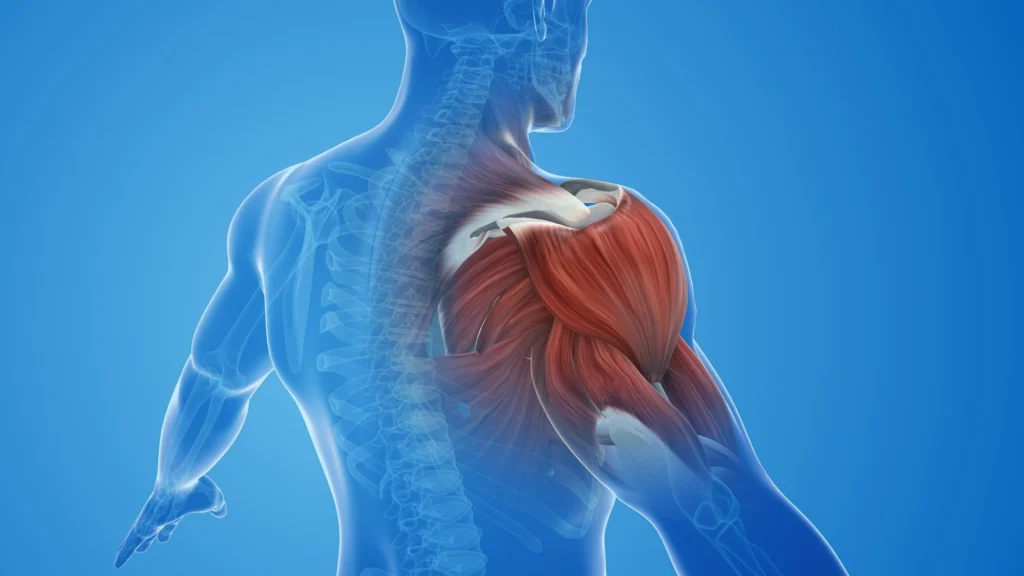
Posture also plays a role in this relationship. The shoulder, neck, and upper spine function as a coordinated unit during almost every movement we make. When one part is injured or compromised, the others often compensate to fill the gap. Over time, these compensatory shifts in how you hold and move your body can create secondary tension, stiffness, and aching in the neck that may feel completely unrelated to your shoulder, but often isn’t.
Common Shoulder Injuries That May Contribute to Neck Pain
Not every shoulder condition affects the neck equally, but several commonly show up alongside neck symptoms.
Rotator Cuff Tears
The rotator cuff is a group of four muscles and their tendons that stabilize and move the shoulder joint. A tear, whether from a sudden injury or years of gradual wear, can change how the entire shoulder girdle functions. When the rotator cuff isn’t doing its job properly, surrounding muscles in the neck and upper back tend to step in to compensate. Over time, this chronic overuse can lead to muscle fatigue and neck pain that builds gradually and quietly.
Shoulder Impingement Syndrome
Shoulder impingement occurs when tendons in the shoulder get pinched between the bones during overhead movements. People with this condition often develop protective movement habits, sometimes called guarding, that place extra strain on the neck and upper trapezius muscles. These muscles run from the base of the skull down to the shoulder blades, and when they are overloaded, this may contribute to neck pain.
AC Joint Injuries
The acromioclavicular (AC) joint sits at the top of the shoulder, where the collarbone meets the shoulder blade. Injuries to this joint may cause pain that radiates upward toward the neck. The muscles crossing this region can become irritated and symptomatic as a result, sometimes making it difficult to tell where the shoulder pain ends and the neck pain begins.
Labral Tears
The labrum is a ring of cartilage that deepens and stabilizes the shoulder joint. Labral tears often result in deep shoulder pain, a sense of instability, and altered movement mechanics that can eventually strain the neck and upper back over time.
Shoulder Osteoarthritis
Chronic joint degeneration in the shoulder gradually limits range of motion. As mobility decreases, patients may rely more on neck and upper back muscles during everyday activities, which can contribute to neck tightness and pain that accumulates slowly over weeks or months.
How a Shoulder Injury Can Cause Neck Pain: The Key Mechanisms
Several distinct pathways help explain how a shoulder injury can cause neck pain. Understanding them can clarify what might be happening in your own situation.
Muscle Compensation and Overload
When you injure your shoulder, the body instinctively moves to protect it. You might hold your arm closer to your body, avoid certain ranges of motion, or shift your posture to minimize discomfort. These are completely natural responses, but they come at a cost.
Muscles in the neck, upper back, and even the opposite shoulder may work harder to compensate for what the injured side can no longer do. The upper trapezius muscle is especially vulnerable to this kind of overload. When it is chronically overworked, it may contribute to muscle tightness, stiffness, or discomfort that can extend into the neck. Many patients don’t realize that this muscle tension is secondary to their shoulder problem.
Referred Pain
Referred pain is pain that originates in one area of the body but is perceived somewhere else entirely. The shoulder has a rich and complex nerve supply, and when deep structures within the joint are irritated or damaged, the brain can sometimes register that pain in a neighboring region, like the neck, upper back, or down the arm.
This is particularly common with rotator cuff pathology and AC joint injuries. Referred pain doesn’t mean the neck itself is damaged. It simply reflects the way the nervous system processes and interprets pain signals, which isn’t always a perfectly accurate map of what’s actually going on.
Nerve Involvement
Some shoulder conditions can directly affect the nerves that travel between the neck and the arm. Compression or irritation of the brachial plexus, whether from a shoulder injury, localized swelling, or sustained postural changes, may produce symptoms in both the shoulder and the neck simultaneously. These symptoms can include pain, tingling, numbness, or a feeling of weakness in the arm or hand.
Recognizing the Signs That Your Neck Pain May Be Shoulder-Related
Figuring out where pain is originating isn’t always straightforward. A few patterns may suggest that your neck discomfort is linked to a shoulder problem.
Pain that seems to travel between the shoulder and neck, or that worsens with arm activity, may point toward a shared source. Neck stiffness that developed following a shoulder injury, rather than after sleeping awkwardly or a minor neck strain, is another potential clue. Tightness concentrated in the upper trapezius area, along with tenderness just above the shoulder blade, may also indicate that the shoulder is the primary driver.
That said, neck and shoulder pain can absolutely coexist independently of one another. A cervical spine condition, like a herniated disc, can send pain radiating down into the shoulder, which is essentially the reverse of what we’ve been discussing. This is precisely why a thorough, professional evaluation matters so much. Treating the wrong structure rarely leads to meaningful or lasting improvement.
When to See a Specialist
Some symptoms are worth paying attention to sooner rather than later. Consider reaching out to an experienced shoulder specialist if:
- Neck pain developed around the same time as a shoulder injury and hasn’t improved on its own
- You’re experiencing numbness, tingling, or weakness that travels from the shoulder into the neck or down the arm
- Your range of motion in the shoulder or neck has become noticeably limited
- Rest and over-the-counter medications haven’t provided meaningful relief after a few weeks
- Your symptoms seem to be gradually worsening rather than improving
How Shoulder-Related Neck Pain Is Diagnosed
When you come in for an evaluation, your doctor will take a detailed history of your symptoms, including how they started, how they’ve changed over time, and what makes them better or worse. A physical exam will assess shoulder and neck mobility, strength, and specific areas of tenderness. Targeted orthopedic tests can help identify where the problem is most likely originating.
Imaging studies are often part of the diagnostic process. X-rays aim to reveal bone changes, structural abnormalities, or signs of arthritic wear in the shoulder. MRI can provide a more detailed look at soft tissue structures, including the rotator cuff, labrum, and surrounding muscles. When nerve involvement is suspected, additional nerve conduction testing may be recommended.
Because shoulder and neck pain can overlap in complicated ways, a systematic and thorough diagnostic approach is essential. Identifying the true root of the problem is what allows treatment to be effective.
Treatment Options
Many cases of shoulder-related neck pain respond well to targeted treatment. The specific approach depends on the nature of the underlying shoulder condition and the overall pattern of symptoms.
Physical Therapy
Physical therapy is often a central component of treatment. A skilled therapist can address both the shoulder mechanics and the compensatory muscle tension that has developed in the neck over time. Strengthening the rotator cuff, improving control of the shoulder blade, and restoring more natural movement patterns may meaningfully reduce the ongoing strain on the neck.
Medications
Anti-inflammatory medications may help manage pain and swelling during the early phases of treatment. These are generally used as a short-term measure while more targeted interventions take effect.
Injections
Corticosteroid injections into the shoulder joint or surrounding bursa may provide significant short-term pain relief. When shoulder pain is well-controlled, the overworked neck muscles may have an easier time relaxing and recovering naturally.
Surgical Treatment
In cases where a significant structural problem, such as a large rotator cuff tear or advanced shoulder arthritis, is the underlying driver of symptoms, surgery may be considered. Depending on the cause, various procedures may be available, including arthroscopic techniques and shoulder replacement.
Summary
Can a shoulder injury cause neck pain? Yes, and it happens more commonly than many people realize. The shoulder and neck are closely intertwined, and problems in one area can and do affect the other. Recognizing this connection is an important first step. Seeking an accurate diagnosis is the next step.
If you’re dealing with shoulder pain that seems to be spreading into your neck, or neck symptoms that appeared around the same time as a shoulder injury, don’t brush it off. The sooner you understand what’s driving your symptoms, the sooner you can take meaningful action.
Frequently Asked Questions
Can a rotator cuff tear cause neck pain?
Yes, it may. A rotator cuff tear disrupts the normal mechanics of the shoulder, which can cause surrounding muscles, including those in the neck and upper back, to overcompensate. Over time, this altered movement and muscle overload may lead to chronic tension and pain in the neck. In some cases, the pain from the rotator cuff injury itself may also refer upward toward the neck region.
Is it possible for neck pain to cause shoulder pain rather than the other way around?
Absolutely. The relationship between the neck and shoulder goes in both directions. A herniated disc or pinched nerve in the cervical spine can send pain signals down into the shoulder, arm, or hand. Distinguishing whether the neck is producing shoulder symptoms, or whether the shoulder is causing neck symptoms, is one of the key reasons a thorough clinical evaluation is so valuable.
Can I manage shoulder-related neck pain at home?
Mild symptoms may respond to rest, gentle stretching, and over-the-counter anti-inflammatory medications. However, if your symptoms are significant, worsening, or accompanied by numbness or weakness, a professional evaluation should be considered.
