

Medically reviewed by Michael V. Cushing, MD
When someone comes into my office after landing hard on the point of the shoulder, one of the first questions I hear is about time. How long until I can use this arm, get back to work, or get back on the field? Shoulder separation recovery time depends mostly on how badly the ligaments were injured. A mild sprain may settle in about two weeks. A more severe injury can take up to three months, and longer if surgery becomes part of the plan. In this post, I’ll walk through what a shoulder separation is, how the grade of injury shapes recovery, and how I approach treatment for patients in Newnan, Fayetteville, and the surrounding communities.
Key Takeaways
- A shoulder separation is an injury to the AC joint, where the collarbone meets the top of the shoulder blade. It is a different injury from a shoulder dislocation.
- Recovery time depends on the grade, ranging from about two weeks for a mild sprain to roughly three months for more severe injuries treated without surgery.
- Most shoulder separations, including many Grade III injuries, can be treated without surgery.
- Surgery is generally reserved for the most severe grades or for symptoms that don’t improve with rehabilitation.
What Is a Shoulder Separation?
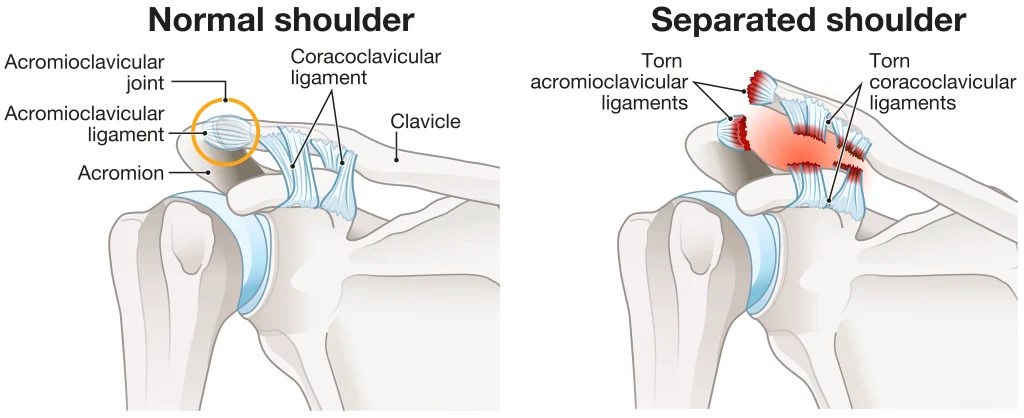
A shoulder separation is an injury to the acromioclavicular joint, or AC joint. This small joint sits at the top of the shoulder, where the outer end of the collarbone (clavicle) meets the acromion, the bony tip of the shoulder blade.
Two sets of ligaments hold it together. The AC ligaments wrap around the joint itself. The stronger coracoclavicular (CC) ligaments sit a little farther in and anchor the collarbone downward.
The name causes a lot of confusion. In a shoulder dislocation, the ball of the upper arm comes out of the socket. In a separation, the ball and socket stay where they belong, and the collarbone shifts relative to the shoulder blade. In my opinion, getting that distinction right at the first visit spares patients a lot of unnecessary worry.
How Shoulder Separations Happen
The typical cause is a direct fall onto the outside of the shoulder with the arm tucked at the side. The impact drives the shoulder blade downward while the collarbone stays put, and the ligaments stretch or tear.
Football, rugby, lacrosse, and hockey are classic sources, along with cycling and mountain biking. Skiing is one of my own hobbies, and a fall on hard-packed snow is a textbook way to land on the point of the shoulder. Plenty of separations happen away from sports, too, from a slip on wet steps or a fall off a ladder.
Grades of Shoulder Separation
Shoulder separations are graded from I to VI based on which ligaments are injured and how far the collarbone has moved.
- Grade I: The AC ligaments are sprained but not torn through. The joint stays aligned, and there’s tenderness without a visible bump.
- Grade II: The AC ligaments tear, and the CC ligaments are sprained. The collarbone may sit slightly higher, creating a small bump.
- Grade III: Both the AC and CC ligaments tear, and the end of the collarbone sits noticeably higher.
- Grades IV through VI: These less common, higher-energy injuries push the collarbone backward, far upward, or downward, and they generally need surgery.
The bump on top of the shoulder worries patients more than anything else. With Grade II and III injuries, some degree of that bump may remain permanently. It’s largely cosmetic, and good, pain-free function frequently returns even when the bump stays.
Shoulder Separation Recovery Time by Grade
Timelines vary from person to person, but the grade gives a reasonable starting estimate. In my sports medicine practice, AC joint sprains treated without surgery tend to recover in about two weeks to three months, depending on severity. Here’s roughly how that breaks down:
- Grade I: about two weeks before the shoulder feels close to normal for daily activities.
- Grade II: around four to six weeks, sometimes a bit longer for overhead work or contact sports.
- Grade III, treated without surgery: roughly six weeks to three months for a full return to sport or heavy labor.
Heavy lifting jobs, contact sports, and overhead athletics can all stretch the timeline. Bench pressing, push-ups, and dips load the AC joint directly, so they’re typically the last activities to return.
Recovery after surgery for a high-grade separation runs longer. Patients commonly wear a sling for about six weeks, followed by a gradual therapy progression. A return to contact sports may take four to six months or more.
What Nonsurgical Recovery Looks Like
For a separation treated without surgery, recovery moves through three broad phases.
In the first one to two weeks, a sling is used for comfort, not because the joint has to be locked in place. Ice and anti-inflammatory medication, when appropriate, can help with pain. I encourage elbow, wrist, and hand motion right away, then gentle shoulder motion as the sharpest pain settles. For a nonsurgical separation, staying in the sling longer than you need to won’t make the ligaments heal better, and it can leave the shoulder stiff.
Next, as pain allows, range of motion returns and a therapy program begins strengthening the rotator cuff and shoulder blade muscles. Reaching across the body, such as grabbing a seat belt or washing the opposite armpit, may stay tender for several weeks.
Once motion is full and strength is close to the other side, sport-specific work begins. For contact athletes, I want to see full, pain-free motion and restored strength before a return to play.
What I See in My Patients
In my Newnan and Fayetteville offices, shoulder separations cluster in a few groups. Fall brings high school and recreational football players. Spring and summer bring more cyclists and mountain bikers. A good number of them walk in convinced they dislocated the shoulder, and they’re relieved to learn the ball and socket are fine.
The recovery mistake I see most is the athlete who feels good at three weeks and goes straight back to full contact or heavy pressing. The pain is gone, but strength and control haven’t caught up. Those are the patients who flare up and lose more time than if they’d built back gradually.
I also see the opposite. A patient keeps the arm in a sling for six weeks after a mild sprain, assuming more rest means better healing. The joint heals, but now they’re working through stiffness that didn’t need to happen.
My Approach to Treating a Shoulder Separation
My approach starts with an exam and X-rays. The X-ray shows how far the collarbone has shifted, and comparing it with the uninjured side helps me grade the injury accurately. I also check the rotator cuff, the labrum, and the collarbone itself, because a hard fall can injure more than one structure at once.
For Grade I and II injuries, I recommend nonsurgical treatment. For Grade III injuries, my default is to start without surgery as well. Research over the past several years has shown that many people with Grade III separations do about as well with nonsurgical care as with surgery, while avoiding the risks of an operation. As a member of the American Shoulder and Elbow Surgeons, I follow that research closely.
Surgery may come into the conversation for Grade IV through VI injuries and for lower-grade injuries that stay painful or unstable despite rehabilitation. Surgery for a shoulder separation generally aims to reconstruct the torn ligaments and hold the collarbone in a better position while they heal. In long-standing cases with arthritis at the AC joint, a procedure that removes a small portion of the end of the collarbone may be considered. The right option depends on the injury pattern, how long ago it happened, and the patient’s goals.
Long-Term Outlook
Most people with a shoulder separation return to their normal activities without lasting limitations. The bump may remain, and some patients notice occasional aching with heavy lifting or bench pressing. In a smaller number of cases, arthritis develops at the AC joint years later, which can often be managed with activity changes or an injection.
Summary
Shoulder separation recovery time depends mostly on the grade: about two weeks for a mild sprain, roughly four to six weeks for a Grade II injury, and up to about three months for a Grade III injury treated without surgery. Most separations heal without an operation, and a well-paced rehab program matters more than how long the sling stays on.
If you’ve recently landed on your shoulder and noticed a new bump or pain at the top of the joint, the best next step is an exam and X-ray to confirm the grade, so your recovery plan matches the injury. You can request an appointment at my Newnan or Fayetteville office or call (770) 502-2175.
Frequently Asked Questions
How long does a shoulder separation take to heal?
It depends on the grade. A Grade I sprain may feel close to normal in about two weeks, a Grade II injury in roughly four to six weeks, and a Grade III injury treated without surgery in about six weeks to three months. After surgery for a severe separation, recovery takes several months, and a return to contact sports may take four to six months or longer.
Will the bump on my shoulder go away?
With Grade I injuries, there’s usually no bump to begin with. With Grade II and III injuries, some bump may remain permanently. It’s mainly a cosmetic issue, and plenty of people with a visible bump regain good, pain-free function.
How long should I wear a sling for a separated shoulder?
For a separation treated without surgery, the sling is for comfort, and many people need it for only the first week or two. I encourage patients to come out of it as pain allows. After surgery, the sling stays on longer, commonly around six weeks.
Is a shoulder separation the same as a dislocated shoulder?
No. A separation involves the AC joint at the top of the shoulder, where the collarbone meets the shoulder blade. A dislocation means the ball of the upper arm has come out of its socket. They’re different injuries with different treatment plans and recovery times.
