

Medically reviewed by Michael V. Cushing, MD | Reviewed May 2026
If you’re considering shoulder surgery, you may be wondering, “How long does it take to recover from shoulder arthroscopy?” Recovery isn’t one-size-fits-all. It depends on which procedure was performed, how your body responds to healing, and how committed you are to rehabilitation. As a shoulder specialist serving patients in Newnan and Fayetteville, I want to walk you through a realistic, phase-by-phase look at what recovery from shoulder arthroscopy can typically involve so you can plan ahead, set reasonable expectations, and give your shoulder the best possible environment to heal.
Key Takeaways
- Simpler procedures, like arthroscopic decompression for shoulder impingement, may allow a return to daily activities within a few weeks.
- More complex repairs, such as rotator cuff repair or labral stabilization, may require 3–6 months or longer before patients return to full activity.
- How consistently you follow your rehabilitation plan is one of the strongest predictors of a successful outcome.
What Is Shoulder Arthroscopy?
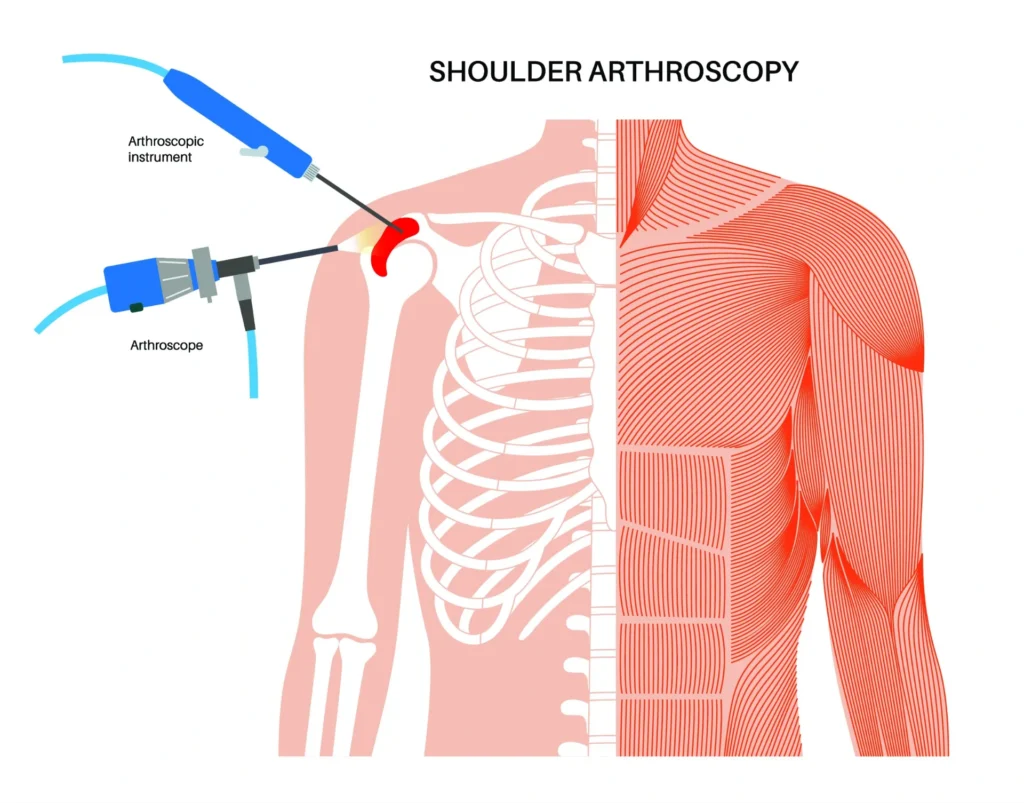
Shoulder arthroscopy is a minimally invasive surgical approach that allows me to both diagnose and treat a wide range of shoulder conditions through a few small incisions, rather than one large open incision. I use a tiny camera, called an arthroscope, to view the inside of the joint in real time on a monitor, while using specialized small instruments through additional incisions to perform the repair.
Because we’re working through smaller incisions, there may be less disruption to surrounding tissue compared to traditional open surgery. In some cases, that can translate to less post-operative pain, reduced scarring, and a faster return to daily life. Tendons, cartilage, and soft tissue still have their own healing timelines, and the shoulder needs time and careful rehabilitation regardless of how small the incisions appear on the outside.
What Conditions Can Shoulder Arthroscopy Address?
One of the main reasons it isn’t possible to give a single recovery timeline is that shoulder arthroscopy can address a wide variety of conditions. The specific procedure performed has an enormous influence on how long recovery takes. Some of the conditions I most commonly treat arthroscopically include:
- Rotator cuff tears: Partial or complete tears of the tendons that surround and stabilize the shoulder joint, often caused by acute injury or long-term overuse
- Labral tears and shoulder instability: Including SLAP tears, where the cartilage ring that stabilizes the socket is damaged, commonly from repetitive throwing or trauma
- Shoulder impingement syndrome: Where soft tissues become compressed in the shoulder space during overhead motion, causing pain and limiting function
- Biceps tendon pathology: Including tendonitis, partial tears, or conditions requiring a procedure called tenodesis
- Frozen shoulder (adhesive capsulitis): Severe cases that have not responded to conservative treatment may require arthroscopic capsular release to free the restricted joint
The Recovery Timeline: A Phase-by-Phase Guide
I’ll tailor a recovery plan specifically for you, but here is a general overview of what recovery from shoulder arthroscopy can look like. Keep in mind that these phases often overlap, and how quickly you move through them depends heavily on the procedure performed and your individual response to healing.
Phase 1: The First Days After Surgery (Days 1–7)
The first week after surgery is about one thing above all else: protecting the repair. You will likely wake up with your arm in a sling. In many cases, your surgical team will have used a regional nerve block before or during the procedure to manage early post-operative discomfort. As the block wears off, I advise patients to stay ahead of the discomfort with their prescribed oral medication rather than waiting until pain has already peaked.
Swelling, bruising around the shoulder and upper arm, and general fatigue are all expected during this phase. Keep your incision sites dry, ice regularly, and rest. The goal right now is not movement. It is protection and early recovery. Most patients are discharged the same day of surgery, but that convenience should not be mistaken for clearance to resume normal activity.
Phase 2: Sling Use and Early Rehab (Weeks 1–6)
Depending on the procedure, you may wear your sling for anywhere from two to six weeks. More complex repairs, particularly rotator cuff repairs and labral stabilization surgeries, tend to require a longer period of immobilization so the repaired tissue can begin attaching and healing properly. This early protection phase is not optional, and rushing past it can compromise the repair.
Physical therapy typically begins within the first one to two weeks following surgery. These early sessions focus on passive range of motion, meaning your therapist is gently moving your arm for you while the muscles remain largely uninvolved. This is deliberate. We want to encourage mobility and prevent stiffness while protecting the healing tissue underneath.
Physical therapy may feel uncomfortable during this phase as stiffness builds. Your therapist can help you differentiate between normal healing soreness and the kind of pain that warrants a call to our office.
Phase 3: Building Motion and Strength (Weeks 6–12)
Around the six-week mark, many patients begin transitioning from passive motion exercises to more active movement. You’re starting to use the shoulder more intentionally, and physical therapy shifts toward rebuilding strength alongside your improving range of motion. For less complex procedures, many patients experience meaningful improvement and return to light daily activities around this point.
For more involved repairs, this phase is still about building a solid foundation. Progress tends to feel more tangible here than it did in the first few weeks. Many of my patients reach encouraging milestones during this window: raising the arm above shoulder height for the first time, sleeping through the night more comfortably, or getting through a full day without pain being the central focus of their experience.
Phase 4: Functional Recovery (Months 3–6)
Months three through six are typically where more substantial strength gains take place and where patients develop a clearer picture of their long-term outcome. For procedures like rotator cuff repair, this is generally the window in which patients return to their full range of daily activity, with recovery spanning the 3–6 month range depending on the size and complexity of the original tear. Rehabilitation during this phase shifts toward strengthening, building endurance, and reintroducing functional movement patterns that reflect your real-world demands. For athletes, this is often the phase where sport-specific training begins. Controlled overhead work, throwing mechanics, and activity-specific drills may be introduced gradually and with intention.
Everyone moves through this phase at their own pace. Some patients feel confident and strong at the four-month mark. Others benefit from additional focused rehab before they are truly ready to return to full activity. This simply reflects the reality of biological healing, which does not follow a fixed schedule.
Phase 5: Tissue Maturation and Full Recovery (Months 6+)
Even once you feel functionally well, the shoulder continues to mature at a tissue level for up to a year or more. This final stage of healing, where repaired tendons and surrounding soft tissue fully remodel, happens quietly in the background, even after formal physical therapy has ended.
Full return to overhead sports, demanding manual labor, or high-impact physical activity may take closer to six months or beyond, depending on the complexity of the original repair. When patients ask how long it truly takes to recover from shoulder arthroscopy, my honest answer is: most people feel functionally strong within three to six months, but giving the tissue a full year to mature is a reasonable expectation for more significant repairs.
Factors That Can Influence Your Recovery Timeline
No two recoveries look exactly alike, and several individual factors can influence how smoothly and quickly you progress through each phase.
The procedure itself is a variable. A minor debridement carries very different healing demands than a complete rotator cuff repair with multiple anchors. More complex repairs require more time. Understanding this from the start helps set realistic expectations. The size and severity of the original injury matter too. A small partial tear has very different healing demands than a large, complete tear.
Age and overall health also play a meaningful role. Younger patients and those without significant underlying health conditions often heal more efficiently. Certain conditions, such as diabetes, can affect tissue repair at a physiological level and may extend the timeline somewhat.
How closely you follow your rehabilitation plan may be the most controllable factor. Skipping physical therapy sessions, neglecting home exercises, or advancing activity levels before you’re ready can lead to stiffness, weakness, or re-injury.
Summary
So, how long does it take to recover from shoulder arthroscopy? The honest answer is: it depends on what was repaired and on you as an individual. For less involved procedures, many patients return to daily activities within a few weeks. For more significant repairs like rotator cuff surgery or labral stabilization, full recovery can take 3 to 6 months, with some patients continuing to improve beyond that. The key is committing to rehabilitation, following your post-operative plan closely, and giving your shoulder the time it genuinely needs. If you’re dealing with a shoulder injury and want to understand your options, I’d encourage you to schedule a consultation so we can build a plan specific to your shoulder, your goals, and your life.
Frequently Asked Questions
Is shoulder arthroscopy considered major surgery?
Shoulder arthroscopy is a minimally invasive procedure. It uses small incisions rather than a traditional open approach. It is still surgery, with a real recovery process attached to it. A simple diagnostic scope or decompression is a very different undertaking from a full rotator cuff repair with multiple anchors. Minimally invasive describes the technique, not necessarily the scope of what was repaired.
When can I return to work after shoulder arthroscopy?
This depends heavily on what your job involves. If you have a sedentary, desk-based role, you may be able to return within one to two weeks, often with some modifications. If your work involves lifting, reaching overhead, sustained physical demands, or repetitive arm movement, you may need to wait until the three-to-six-month mark or beyond. Your surgeon will provide specific return-to-work guidance based on the procedure performed and a realistic understanding of your job’s physical requirements.
What should I watch for during recovery that might signal a problem?
While some degree of swelling, bruising, and soreness is expected and entirely normal, certain signs deserve a prompt call to your surgeon. These include increased warmth or redness around the incision sites, unexpected drainage or discharge, a significant spike in pain that does not respond to medication, fever, or a sudden noticeable change in shoulder function. Shoulder arthroscopy is generally a safe procedure with a low complication rate, but like any surgery, it carries some risk. When in doubt, reach out.
