


Medically reviewed by Michael V. Cushing, MD | Reviewed July 2026
Shoulder bursitis is a common reason patients walk into my Newnan and Fayetteville offices. It usually starts small, maybe after a weekend of yard work, a stretch of extra laps in the pool, or one too many buckets at the driving range. Before long, a simple reach into an overhead cabinet turns into something you think twice about. In this post, I want to walk you through what causes shoulder bursitis, what it tends to feel like, and what I typically recommend when a patient in my chair is dealing with it.
Key Takeaways
- Shoulder bursitis develops when the subacromial bursa, a small fluid-filled sac that cushions your rotator cuff tendons, becomes inflamed and irritated.
- Repetitive overhead motion, direct trauma, and poor shoulder mechanics are among the most common triggers I see in my practice.
- Most cases respond well to rest, ice, anti-inflammatory medication, and a focused physical therapy program.
Understanding the Bursa and Your Shoulder
The shoulder relies on a small but important structure called the subacromial bursa. This thin, fluid-filled sac sits between the top of your rotator cuff tendons and the acromion, which is the bony ridge that forms the roof of your shoulder.
Its job is fairly simple: it reduces friction so your tendons can glide smoothly every time you lift, reach, or rotate your arm.
Under normal circumstances, you never notice this bursa is even there. Problems start when it becomes irritated and swells with extra fluid. That swelling takes up space in an already tight area, and the added pressure is often what produces the sharp, nagging pain associated with shoulder bursitis. Because the bursa sits so close to the rotator cuff and the shoulder joint itself, bursitis rarely occurs in complete isolation. It tends to travel with other issues, which is part of why an accurate diagnosis matters.
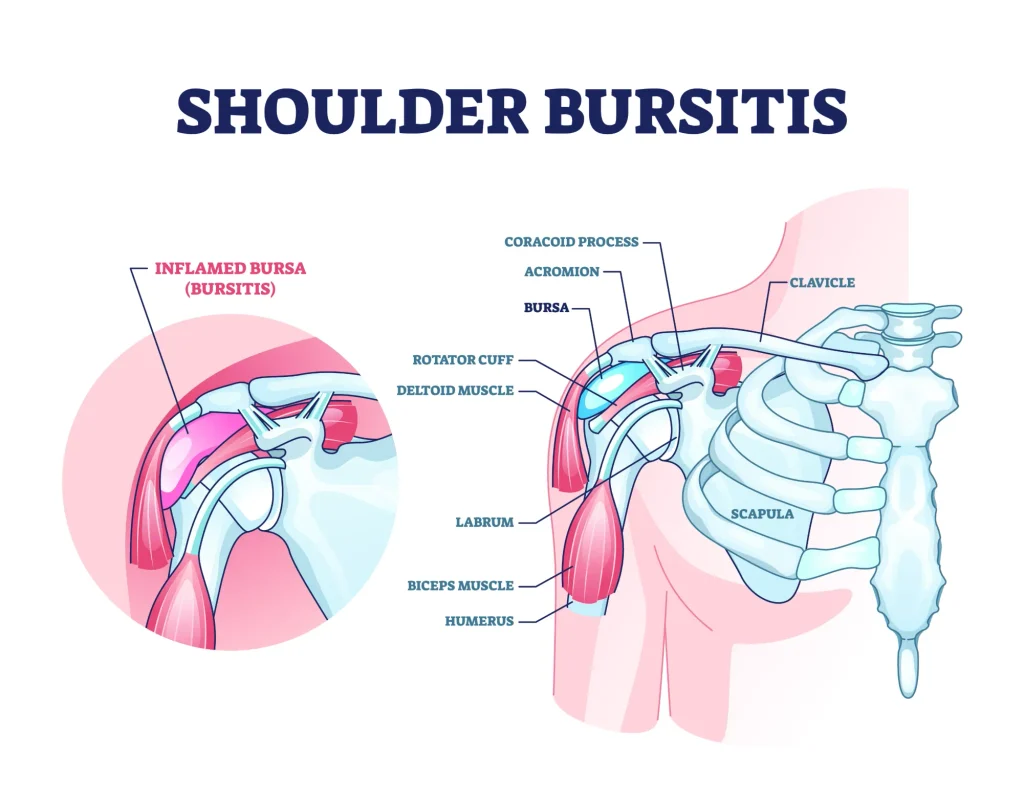
Several other structures work alongside the bursa to keep the shoulder moving smoothly. The rotator cuff tendons pass directly beneath it, the acromion arches over the top of it, and the deltoid muscle wraps around the outside of the joint. A bursa that swells even a modest amount can crowd the tendons beneath it, which is part of why bursitis and impingement so often travel together as a package rather than as two separate problems.
How Shoulder Bursitis Is Diagnosed
Diagnosing shoulder bursitis usually starts with a conversation and a hands-on exam. I ask patients where the pain sits, what movements bring it on, and whether anything specific, like a fall, a new workout routine, or a change at work, lined up with when the symptoms began. From there, a physical exam that checks range of motion, strength, and specific pain-provoking positions can usually point toward bursitis fairly reliably.
Imaging isn’t always necessary for a straightforward case, but in some cases, it may be useful. An ultrasound can show bursal swelling in real time and is a quick, well-tolerated option in the office. MRI offers a more detailed look and can help rule out a rotator cuff tear or labral issue if the exam findings suggest something beyond bursitis alone. X-rays don’t show the bursa directly, but they can rule out bone spurs or arthritic changes that may be contributing to the irritation.
What Causes Shoulder Bursitis?
There isn’t a single cause behind every case, but a handful of patterns show up again and again in the patients I evaluate.
Repetitive overhead activity is probably the most frequent trigger. Painting a ceiling, swimming, serving in tennis, throwing, and even certain manual labor jobs all involve the same motion repeatedly. Each repetition compresses the bursa slightly, and over days or weeks, that repeated friction can tip it into an inflamed state.
Direct trauma is the other major category. A fall onto an outstretched arm, a hard bump to the point of the shoulder, or even sleeping on the same side night after night can irritate the bursa enough to set off symptoms.
Poor shoulder mechanics also play a role. When the muscles that stabilize your shoulder blade aren’t working the way they should, the space beneath the acromion can narrow, and the bursa ends up getting pinched more than it was designed to handle. This is closely tied to shoulder impingement, and the two conditions frequently overlap.
Age-related changes matter too. As tendons lose some of their elasticity over time, the tissues around the shoulder become a bit less forgiving of repetitive stress, which can make bursitis more likely later in life.
In my experience, the patients who improve fastest are usually the ones willing to address the movement pattern that caused the irritation in the first place, not just chase the pain itself. Treating the symptom without correcting the mechanics behind it tends to invite a repeat visit down the road.
Who Is Most at Risk
A few factors tend to raise someone’s likelihood of developing shoulder bursitis. None of them guarantee that you’ll deal with it, but they show up often enough in my patient population that they’re worth understanding.
Age is one factor, since tendons and surrounding tissue gradually lose some resilience over the years, making the bursa more reactive to stress than it might have been at twenty-five. Occupation plays a role as well, particularly for anyone whose job involves repeated overhead reaching. Athletic activity matters too, which is something I address often in my sports medicine practice. Swimmers, tennis players, and golfers place a lot of repetitive load through the same overhead pathway, round after round or lap after lap.
Posture is another possible contributor. A rounded, forward-shoulder posture can quietly narrow the space beneath the acromion over time, setting the stage for irritation even without an obvious triggering event. Finally, previous shoulder injuries can leave the joint mechanics slightly altered, which sometimes increases the odds of bursitis showing up later.
What I See in My Patients
Across my offices in Newnan and Fayetteville, recreational golfers, weekend gardeners, and swimmers make up a large share of the patients I see with shoulder bursitis.
What I notice most often is that patients wait longer than they should before coming in. Bursitis pain has a habit of easing up with a few days of rest, then flaring right back up the moment activity resumes. That stop-and-start pattern can go on for months if it isn’t addressed properly.
The pain itself typically sits over the top or outer edge of the shoulder, and it tends to worsen with overhead reaching or lifting. Many patients describe tenderness when pressing directly on the outside of the shoulder, and quite a few mention that the pain is worse at night, especially if they roll onto that side while sleeping. A smaller number notice a subtle clicking or catching sensation, which usually points to some irritation of the surrounding tendons as well.
My Approach to Treatment
My starting point for shoulder bursitis is almost always conservative, and I tell patients that directly during their first visit. There’s rarely a need to rush toward anything invasive when this condition responds so well to more measured care.
I typically recommend a short period of activity modification paired with ice, along with an anti-inflammatory medication if there’s no reason to avoid one. From there, physical therapy becomes a key treatment component. A good therapist will focus on scapular mechanics and rotator cuff strengthening, not just the painful area itself, because correcting the underlying movement pattern is what keeps bursitis from becoming a recurring problem.
For patients whose symptoms don’t settle within a few weeks, I may recommend a corticosteroid injection into the bursa. It can reduce inflammation quickly and give a course of physical therapy a real chance to work.
Surgery is rarely necessary for shoulder bursitis on its own. In the small number of cases where an arthroscopic bursectomy becomes appropriate, it’s usually because there’s an additional issue, like a significant rotator cuff tear or persistent impingement, that hasn’t improved with other treatment.
Preventing Shoulder Bursitis
While not every case of shoulder bursitis can be prevented, a few habits may help lower the odds of it developing or coming back:
- Warm up before overhead activity. A few minutes of shoulder-specific movement before golf, swimming, or yard work helps prepare the tendons and bursa for what’s ahead.
- Build in rest between repetitive sessions. Back-to-back days of heavy overhead activity don’t give the bursa time to settle, which can allow low-grade irritation to build.
- Strengthen the muscles around the shoulder blade. Strong scapular stabilizers help keep the space beneath the acromion open, reducing unnecessary friction on the bursa.
- Pay attention to posture, especially if you spend long hours at a desk. Small adjustments can reduce the chronic forward-shoulder position that contributes to impingement-type symptoms.
- Don’t ignore early symptoms. A little soreness that fades quickly can be a signal worth listening to before it turns into a more persistent problem.
Summary
Shoulder bursitis is common, treatable, and in most cases, manageable without surgery. The condition tends to develop from repetitive overhead motion, direct trauma, or shoulder mechanics that have quietly drifted out of balance, and it often overlaps with rotator cuff tendinitis or impingement. If your shoulder pain has lingered for more than a couple of weeks, or it’s starting to interfere with sleep and daily activities, don’t wait it out on your own. Schedule a visit at either my Newnan or Fayetteville office so we can figure out exactly what’s driving your symptoms and get you on a plan that addresses it.
Frequently Asked Questions
Is shoulder bursitis serious?
Shoulder bursitis is rarely dangerous on its own, but it can be disruptive if it’s left untreated. Ongoing inflammation may lead to more restricted motion over time, and it can sometimes mask or contribute to other issues, such as rotator cuff irritation.
Can I still exercise with shoulder bursitis?
Some modified activity is often fine, but activities that involve repetitive overhead motion, like swimming or overhead lifting, usually need to be scaled back or paused temporarily. I tailor these recommendations to each patient’s specific symptoms and activity goals.
Do I need surgery for shoulder bursitis?
Surgery is uncommon for shoulder bursitis by itself. Most patients respond well to conservative treatment. Surgical options are generally reserved for cases with an additional structural problem, such as a rotator cuff tear, that hasn’t responded to other measures.
What’s the difference between bursitis and a rotator cuff tear?
Bursitis involves inflammation of the fluid-filled sac that cushions the shoulder, while a rotator cuff tear involves actual damage to the tendon tissue itself. The two can feel similar and sometimes occur together, which is why a hands-on exam, and occasionally imaging, helps clarify exactly what’s causing your symptoms.
